Wednesday, July 9, 2008

A Tale of Two Cities: Vote-Off

It's a tie!

You've selected Odessa (Ukraine, not Texas) and Krakow as the two cities you'd most like to visit on our tour. I would chalk this up as a semi-surprising outcome, given Budapest's billing as the "New Prague," had I not circulated this blog with the Ukrainian and Polish groups on JewishGen. Which may have distorted the vote slightly.

Either way, The Stewart Bike Trip shudders in the face of a murky outcome, so we're holding a runoff between Odessa and Krakow. Vote early and often - the options are listed in the right column.

To help you in this critical decision, I've included the funnest facts I could find from each city's Wikipedia article:

First up: Odessa, birthplace of my great-grandmother, Eva Schwartz:
According to one of the stories, when someone suggested Odessos as a name for the new Russian port, Catherine II said that all names in the South of the Empire were already 'masculine,' and didn't want yet another one, so she decided to change it to more 'feminine' Odessa. This anecdote is highly dubious, because there were at least two cities (Eupatoria and Theodosia) whose names sound 'feminine' for a Russian; besides, the Czarina was not a native Russian speaker, and finally, all cities are feminine in Greek (as well as in Latin). Another legend derives the name 'Odessa' from the word-play: in French (which was then the language spoken at the Russian court), 'plenty of water' is assez d'eau; if said backwards, it sounds similar to that of the Greek colony's name (and water-related pun makes perfect sense, because Odessa, though situated next to the huge body of water, has limited fresh water supply). Regardless, a link with the name of the ancient Greek colony persists, so there might be some truth in the oral tradition.
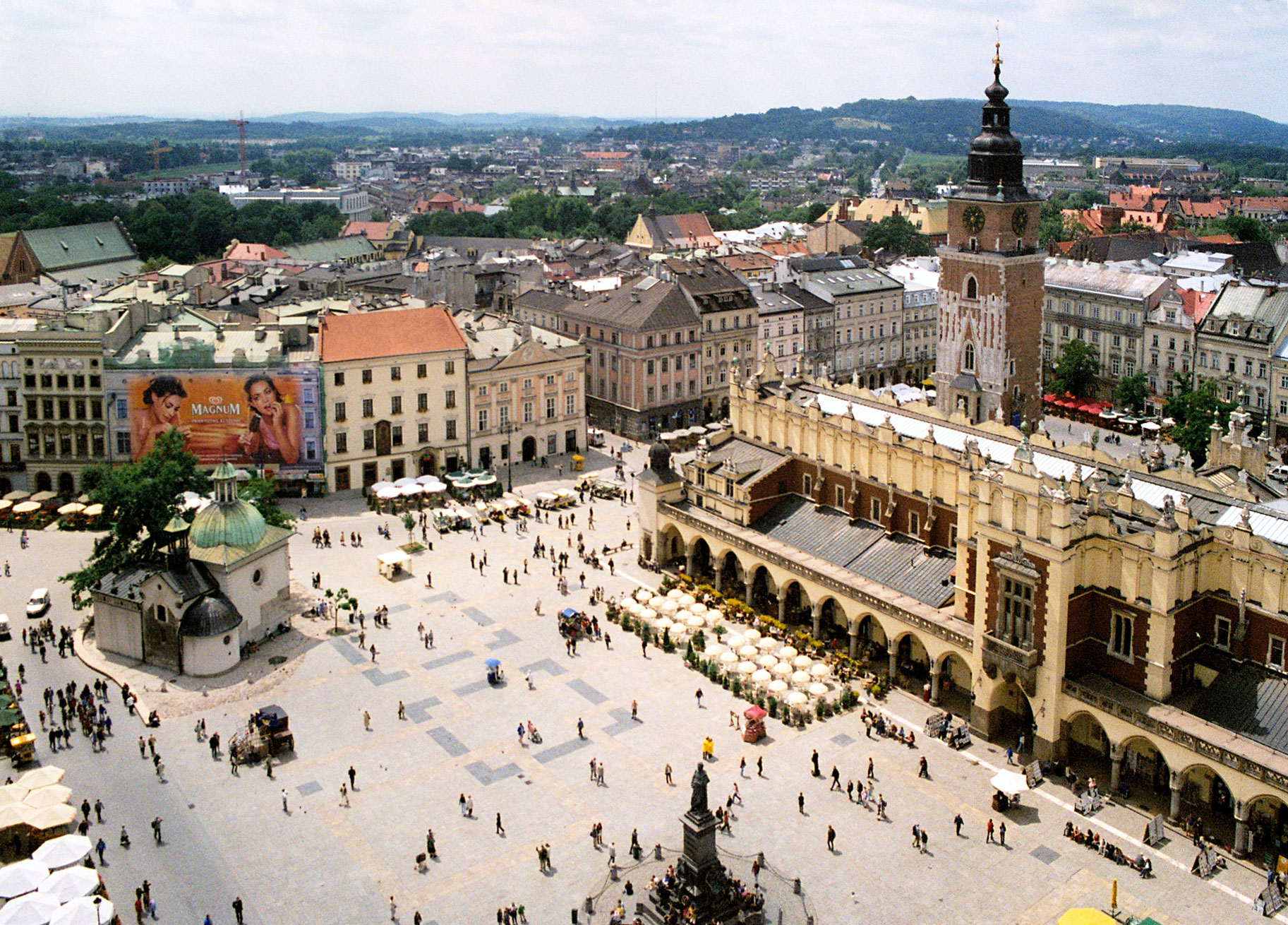
Option 2: Krakow, one of the oldest and largest cities in Poland, and one of the few to emerge relatively unscathed from the wrath of WWII:
Kraków remained relatively undamaged at the end of World War II.[43] Allegedly Germans planned to destroy it with massive amounts of explosives,[44][45] but according to the most popular of several versions of the story,[46] Soviet Marshal Ivan Konev, after being informed by the Polish patriots of the German plan,[45][47] tried to preserve Kraków from destruction by ordering a lightning attack on the city.[48] The credibility of these accounts has been recently questioned by Polish historian Andrzej Chwalba, who in his recent works finds no evidence for any German plan of massive destruction and portrays Konev's strategy as ordinary, only accidentally resulting in reduced damage to Kraków, a fact that was later exaggerated into the myth of "Konev, savior of Kraków" by Soviet propaganda.
Disclaimer: The Stewart Bike Trip is clearly biased in favor of Odessa on this one, as 1. it was it home to a wonderful woman who is in part responsible for our existence and 2. when we arrive in Odessa, it means we won't have to ride our bikes for at least a couple of days. Yet - in stark contrast to the history of both these nations - we value fair and free elections, so please, vote with a clear conscience and in the full spirit of democracy.
Digg this

Tuesday, July 8, 2008

Tour de Farce

A number of my friends have alerted me that the Tour de France has started up again, assuming that due to my interest in cycling and impending cycling trip to Europe I would naturally want to be involved.

I appreciate that it's really hard to cycle that hard and that fast for that long. I appreciate the thrill of the chase, the need for speed, the visual excitement of massive accidents. But, largely because of Lance Armstrong, I just don't care.

Why hate on Lance? Partly it's because I thought his book was terrible (and a really bad intra-office holiday gift, by the way), which portrayed him as a thoughtless, arrogant jerk on all levels. Partly it's because he probably cheated (though likely steroid use hasn't deterred me from buying limited edition Barry Bonds jerseys). The Livestrong yellow bracelet fad rang false to me, creating this sense that people who'd merely spent a buck on a piece of rubber were suddenly tough and altruistic, and had license to advertise it to the world. All together, not enough to disrupt my gentle television habits of Giants baseball and Seinfeld reruns.

Gently segueing away, my friend and former writing-group partner Meredith Norton recently published a terrific new memoir called Lopsided about dealing breast cancer. The book was originally titled F You Lance Armstrong, because when Meredith was diagnosed she received countless copies of Lance's book. Unsurprisingly, rather than being strong and powerful during her cancer treatment, Meredith was unable to go on five-hour weakling bike rides and instead felt, well, as if radioactive material was being put into her bloodstream. Which may be
another reason why I'm not into Lance, and not into the Tour.
Digg this

Monday, July 7, 2008

Novel Training Techniques

Rocky warmed up for his big title fight with Appollo Creed by whacking around some sides of beef in Paulie's meat locker. For our mad dash across Eastern Europe, I have to get used to hauling some extra weight around on the bike (other than any extra weight clinging to my own corpus).

The answer? A genuine pauzer-carrier, barely visible on th back of my bike in the photo above, taken last Thursday on the Monocacy Bridge on the C&O Canal trail. OK, some explanation.

The pauzer is "Tramp," a poodle/schnauzer mix. Some people call them "schnoodles," but that does not match Tramp's personality, so we call him a pauzer.

Nancy has rigged up a way to strap Tramp onto the back of the bike, and off I go with 18 pounds of squirming pooch on my rear wheel. More often, actually, Nancy takes the hound on her bike, but this is training time for me. Can't wait for it to end.

As for the less-than-cheerful look on my face? We waited too long for lunch, and I was about out of gas. Another tip for the long-distance cyclist: eat early and often.
Digg this

Sunday, July 6, 2008

JOBY sponsors the Stewart Bike Trip

While enduring another hair-pulling Giants loss v. the Cubbies last week, my pal Joel graciously added to the pile of free corporate booty to the Stewart Bike Trip courtesy of his company, JOBY. Throughout the trip, you'll enjoy stable, wiggle-free photos of me and my dad inflicting cycling dominance across Eastern Europe thanks to our brand new Gorillapod.

I've always liked the look of this thing in the store. It's very versatile - it holds your camera on an uneven surface, you can wrap it around poles/tree, bike handlebars, etc. Also, for those of you adjusting to the new California hands-free car calling law, look into Joby's slick new Zivio bluetooth headset coming out soon - extremely cool-looking and, also, high-quality (as Joel puts it, it's for people who realize their first bluetooth headset isn't any good).

Interested in sponsoring a good old fashioned father-son cycling adventure through history? Shoot me an email and let's talk: mjfstewartATgmailDOTcom.

Digg this

Saturday, July 5, 2008

Cycling picture of the year

This needs no elaboration, other than the disclaimer that this was NOT photoshopped.

Incredible, scary, ridiculous. We aim to avoid this kind of situation at all costs - though how much can you really do about drunk drivers falling asleep at the wheel? They could have hit another car, a pedestrian, a tree.

As with so much in life, on many levels this comes down to pure luck.
Digg this

Friday, July 4, 2008

Isaacs of Poland and Odessa


To prepare for our journey from Warsaw to Odessa, Matt and I are scrambling to read about these very unfamiliar lands. My reading so far has reinforced a point I stumbled across some years back, when some essayist announced that if you want to know what a place was like in the past, read a novel from that time and place. History books won't capture the same sense of the place. Even though I'm a writer of historical narratives, I agree.

For Jewish Poland in the years before the Nazis came, Isaac Bashevis Singer (left) is a wonder. I feel a very slight connection to Singer, since my first literary agent also represented him and still represents his estate -- afer all, what separates Singer and me but the odd Nobel Prize for Literature (1978, if you're wondering)?

I just read one of his lesser-known novels, Shosha, about a writer in Poland between the world wars. Much of it may be autobiographical, as Singer was a young writer in Poland until 1935, when he came to the United States. It is a remarkable book about a young Jewish writer's drift and blundering in that impossible world, and helps to answer the frequent question in my mind about every Jew in Poland in 1935 who had 20 zlotys to rub together -- why didn't they leave? He depicts a world of richness and depth that, though plainly doomed, would be difficult to leave. And the writing! Even in translation (from Yiddish), how about these?

[Opening line of the book]: "I was brought up on three dead languages -- Hebrew, Aramaic, and Yiddish (some consider the last not a language at all) -- and in a culture that developed in Babylon: the Talmud."

[As the crisis nears]: "[D]eath is too important to absorb all at once. Those who commit suicide want to escape death once and for all. But those who aren't such cowards learn to enjoy its taste."

[Epilog, in Israel]: "The newcomers are all out of their minds -- victims of Hitler, bundles of nerves. They always suspect they're being persecuted. First they cursed Hitler, now they curse Ben-Gurion. Their children or perhaps their grandchildren will be normal if the Almighty doesn't send a new catastrophe down upon us. What can you know of what we went through!"

We also were excited to find out about Isaac Babel, (right) an Odessa Jew and Communist revolutionary who wrote "Tales of Odessa." Here was a chance, we figured, to peer into that remarkable, polyglot culture before the Germans and Rumanians literally burned it up. Alas, the pickings were far more slim.

Babel's stories about the worldly Jewish gangsters of Odessa occasionally evoke a powerful scene or sketch a remarkable character, but I did not find they really were stories. There was little narrative or character development -- mostly just snapshots. Others of his stories may be more effective, but these were a disappointment.
Digg this

Wednesday, July 2, 2008

Around the World on a Bicycle


To those who insist our cycling journey through Eastern Europe is nuts, I recite in our defense the extraordinary book by Thomas Stevens, Around the World on a Bicycle, published in 1887!

The title is a slight exaggeration. Mr. Stevens -- who rode that wacky contraption with the gigantic front wheel -- did not actually ride all the way around the world. He walked part of it, and skipped part. But I'll give him the title.

Born in Britain, Stevens came to Missouri with his family and worked as a miner and mill worker. Somehow he formed a desire to ride around the world on one of those new-fangled bicycle things and bought one for $110, a hefty sum in those days. He left from San Francisco, traveling east, and crossed the United States in a summer. The following year, having prudently used a ship to get to England, he cycled across England, Europe, and through Turkey, and India. Tired yet?

The farther east he traveled, the greater the novelty of his bicycle. He attracted larger and larger crowds. In Calcutta, Stevens decided to bypass Burma and Southeast Asia, hopping another ship to Hong Kong. He then pedaled to Shanghai. Another ship brought him to Japan, where he rode from Nagasaki to Tokyo, and finally back home.

Stevens has it all over us on some points. First, he went a lot farther. Second, the roads were so bad that he carried and walked his cycle a lot. Indeed, he developed a method of crossing small streams by placing the cycle in the center, bracing his hands on the machine, and vaulting over the water. Third, I think our machines are better designed. Stevens cheerily records a number of occasions on which he took a "header" over the handlebars of his ungainly craft, referred to as a "high wheel" or "penny farthing." Ouch. Also, Stevens carried a pistol at all times, blazing away at passing wildlife. Though he faced some very ticklish threats from the local people in several places in Asia, he never resorted to gunplay. He figured it would only slow down his journey.

We're hoping to do as well as Stevens did in finding gracious hosts, shelter, and adequate food.

And we are, I must admit, hoping to produce a better book after the ride. I have been slogging through Stevens' tome for some time -- while reading other things, as is my pattern -- and am up to p. 156 (Hungary) out of 470. The prose does not sing. He adopts a bantering, matey, generally patronizing tone about the quaint locals and scenes he encounters. The tone, in short, is entirely tedious and undermines even potentially charming scenes.

Still, there are nuggets in the book, such as his ride through the Hungarian countryside with "Igali," with whom he takes turns whistling "Yankee Doodle" and the Hungarian national anthem, occasionally inserting "God Save the Queen" and "Britannia Rules the Waves" in response to Igali's "Marseillaise." Maybe we'll run into Igali's great-great-granddaughter.

The spirit of Stevens still lives. Lining up for a parade this spring -- when you're married to a public official you get a convertible so you can drive her through parades -- a squad of "high wheel" cyclists gathered. I sauntered over and mentioned that I was reading about a guy who rode one of those things around the world. "Oh, yeah," one said, "Thomas Stevens."

Heckuva guy.
Digg this